
A UK marketing director once told us about the moment her stomach dropped. She’d just hired a freelancer through a global gig platform to manage her email list — 14,000 subscribers, years of campaign history, the lot. Three weeks in, she realised she had no idea where that data physically lived, who else could see it, or whether a single line of paperwork existed to make the arrangement lawful. No contract clause. No data processing agreement. No record of where the freelancer was even based. Just a login she’d handed over and a vague hope that nothing would go wrong.
Nothing did go wrong, as it happens. But “nothing went wrong” is not a data protection strategy. It’s a coin flip you keep winning until you don’t.
This is the quiet anxiety humming underneath every decision to bring in remote support. You want the help. You need the help. But the second someone outside your building can see your customer records, your invoices, your client correspondence, you’ve created what the regulators call a “restricted transfer” — and the rules around that are not optional, not forgiving, and increasingly not cheap to get wrong. The maximum fine for serious infringement under UK data protection law sits at the higher of £17.5 million or 4% of worldwide turnover. That number isn’t aimed at you specifically. But it sets the tone for how seriously the whole system takes a slip.
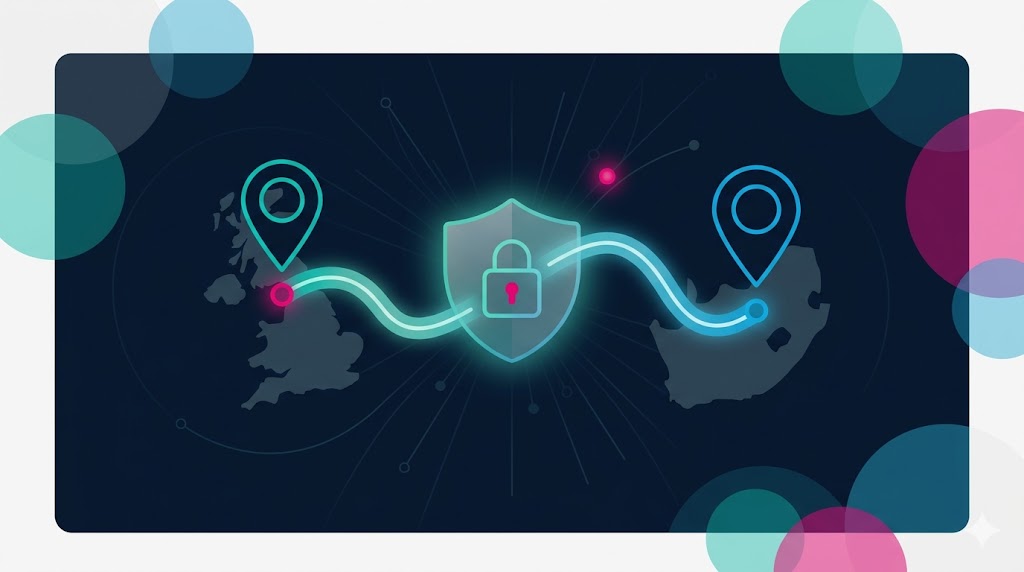
So here’s the thing we want to be upfront about: hiring a virtual assistant in South Africa to support a UK business is a cross-border data transfer. Every time. There’s no version of this where it isn’t. The question is never whether you’re transferring data internationally — it’s whether the person you’ve hired has actually built the legal and technical scaffolding to do it properly, or whether they’re crossing their fingers like that marketing director did.
We built VAConnect’s entire compliance posture around the second answer being unacceptable. Here’s exactly how it works, and why “dual GDPR + POPIA” isn’t a marketing phrase but a genuine structural advantage.
What “Restricted Transfer” Actually Means for You
Let’s clear up the most common misunderstanding first, because it trips up smart people constantly.
When your South African VA logs into your CRM from Cape Town, you haven’t avoided a data transfer by keeping the data “in the UK.” The ICO is explicit that remote access counts. As one UK data protection specialist put it, the moment your assistant accesses client information from outside the country, you’ve made what’s formally known as a cross-border transfer via access — and you, the UK business, are on the hook as the data controller.
This matters because of how UK GDPR is structured. Personal data can flow freely to countries the UK has granted an “adequacy” decision — territories judged to offer equivalent protection. South Africa is not currently on that list. So a transfer of personal data from the UK to South Africa is a restricted transfer, which means you need a lawful mechanism in place before any data moves.
A restricted transfer isn’t a technicality you can paper over later. It’s a legal precondition. The data shouldn’t move until the safeguard exists — not the other way around.
The mechanism most relevant here is the International Data Transfer Agreement, the IDTA. The IDTA and the UK Addendum came into force on 21 March 2022, and organisations can now use the IDTA or the UK Addendum as a mechanism to comply with UK GDPR’s requirement under Article 46 to take appropriate safeguards when making restricted transfers. In plain terms, when your organisation transfers UK data to a non-adequate third country, the IDTA acts as a set of binding data protection clauses — similar to the old EU Standard Contractual Clauses — to meet the Article 46 requirements.
There’s a second piece most people miss entirely. Signing an IDTA isn’t the finish line. Using an IDTA does not remove the requirement to assess whether the destination country’s laws undermine the protection the agreement provides; a Transfer Risk Assessment should be conducted before relying on contractual mechanisms. The ICO publishes a tool for exactly this purpose, and the assessment has to be recorded.
So the honest, full picture of a lawful UK-to-SA arrangement looks like this: a data processing agreement defining roles, an IDTA (or the EU SCCs plus the UK Addendum) providing the transfer safeguard, a documented Transfer Risk Assessment, and the security measures to back it all up. That’s four distinct things working together. A freelancer on a gig platform almost never has any of them. We have all four, built in, before you’ve sent your first email.
It helps to see how these pieces interlock rather than treating them as a checklist. The data processing agreement establishes that you are the controller deciding why and how data is used, and the assistant’s role is to process it on your instructions — that allocation of responsibility is the foundation everything else rests on. The IDTA or Addendum then provides the binding clauses that make the transfer to a non-adequate country lawful under Article 46. The Transfer Risk Assessment is the step where you actually look at whether South African law and practice could undermine those clauses — and this is precisely where POPIA’s close alignment with GDPR makes the assessment come out well rather than badly. Finally, the technical security measures are what make all the paperwork meaningful in practice; a perfect contract protecting data that’s then emailed around in plaintext is a contract protecting nothing. Each layer assumes the others are present. Remove one and the structure stops holding weight.
Two Laws, One Posture — and Why That’s Rare
Here’s where the South African angle stops being a complication and starts being a genuine edge.
A UK business sending data to most low-cost outsourcing destinations faces a one-sided problem: UK law applies to the export, but the receiving country may have weak or unenforced privacy rules. The protection effectively stops at the border. The contract says the right things, but there’s no local legal regime giving them teeth.
South Africa is different, because of POPIA — the Protection of Personal Information Act. And POPIA was deliberately built to look like a familiar European framework. Both regulations allow administrative and monetary penalties; the GDPR’s definitions of ‘data controller’ and ‘data processor’ align with POPIA’s ‘responsible party’ and ‘operator’; GDPR and POPIA have identical legal grounds for processing personal data and establish conditions for consent; and both allow binding corporate rules for international data transfers. The overlap is substantial — accountability, purpose limitation, security safeguards, data subject access and erasure rights, breach handling. If you know GDPR, POPIA reads like a close cousin.
That alignment means your South African VA isn’t operating in a privacy vacuum. POPIA is South Africa’s main data privacy law, applies to all organisations that process personal information within South Africa, and is enforced by the Information Regulator, with maximum administrative fines reaching ZAR 10 million and serious offences carrying up to ten years imprisonment. Your assistant is bound by genuine, enforceable obligations on their side of the transfer — not just whatever your contract happens to say.
The dual posture means protection doesn’t stop at the UK border. UK GDPR governs the export; POPIA governs what happens on arrival. Two enforceable regimes, pointing the same direction.
POPIA’s cross-border rules complete the loop. A responsible party in South Africa may not transfer personal information to a third party in another country unless the recipient is subject to a law, binding corporate rules, or a binding agreement that upholds principles substantially similar to POPIA’s conditions, including provisions on further transfers. So onward sharing is restricted from the South African end too. The data can’t quietly leak sideways to a fourth party without the same standard applying.
One technical curiosity is worth a mention, because it occasionally matters for B2B clients. POPIA protects more than just individuals. GDPR applies to all natural persons regardless of nationality or residence, while POPIA applies to both natural and juristic persons. In practice this means your company records — not only the personal data of named humans — can fall under POPIA’s protection in South Africa. For a UK firm handing over commercially sensitive client lists, that’s a quiet bonus rather than a burden.
The Gap Between “Aligned” and “Identical”
We’d be doing you a disservice if we pretended POPIA and GDPR were the same law in two accents. They aren’t, and the differences are exactly where a careless provider gets a UK client into trouble.
The most important divergence is adequacy itself. The EU maintains a formal list of countries with adequate data protection; POPIA has no such list, and each responsible party conducts its own adequacy assessment for cross-border transfers. This is why the IDTA and Transfer Risk Assessment we mentioned earlier aren’t replaced by POPIA’s existence — they sit alongside it. POPIA’s alignment is what makes the Transfer Risk Assessment come out favourably; it doesn’t make the assessment unnecessary.
There are smaller, sharper differences too. POPIA requires opt-in consent for all unsolicited electronic communications, whereas the GDPR permits direct marketing to existing customers under the legitimate interest basis in certain circumstances. If your VA is running email campaigns, that distinction shapes how lists get handled. It’s the kind of detail that only surfaces when the people managing your data actually understand both regimes — not just one of them with a vague awareness that the other exists.
This is precisely the territory where the “managed, not matched” model earns its keep. A solo freelancer, however well-meaning, is unlikely to have mapped the seams between two legal frameworks. That’s not their job, and it’s unfair to expect it of them. It is, however, exactly our job.
The UK Rules Just Changed — Here’s What That Means
If you set up a remote arrangement two years ago and assumed the rules were static, they weren’t. UK data protection law has just gone through its biggest shift since UK GDPR launched.
The Data (Use and Access) Act 2025 became law on 19 June 2025, bringing reforms to the UK’s data protection regime including changes to the powers and composition of the regulator, with many provisions taking effect on 5 February 2026. The implementation has been deliberately phased, which means parts of it are live now and parts arrive later in 2026.
A few changes matter directly to anyone working with virtual assistants. The Act introduces a seventh lawful basis for processing personal data under Article 6(1): ‘recognised legitimate interests’, a category for which no balancing test is required, though the processing must still be necessary. There’s also a new route for complaints. Data subjects have a new right to complain directly to controllers if they believe a controller has infringed UK data protection rules, in addition to the existing right to complain to the regulator — now renamed the Information Commission.
For most UK SMEs the reform is more reassuring than alarming. While the Act introduces some additional rules to integrate into compliance programmes, in many respects it increases regulatory clarity, codifies existing guidance, and reduces red tape. And crucially for the UK-SA corridor, the broader assessment is that the UK’s adequacy standing with the EU is expected to hold. The view among legal commentators is that it currently seems highly unlikely the reform process will result in the UK losing its adequacy status, particularly as UK GDPR still represents the regime most closely aligned to EU GDPR.
Rules don’t sit still. A compliance posture that was correct in 2024 needs maintaining in 2026. The question to ask any provider is simple: who’s tracking the changes — you, or them?
The penalty regime around adjacent rules also tightened. Penalties for non-compliance with cookie consent rules are now aligned with UK GDPR penalties — the higher of £17.5 million or 4% of worldwide turnover for serious infringements — a significant increase from the previous £500,000 maximum. The stakes for getting the basics wrong have risen, not fallen.
Here’s our honest position on all this: keeping pace with regulatory change is our overhead, not yours. When the Information Commission publishes new guidance through 2026 — and more is expected on the complaints process arriving 19 June 2026 — that’s something we monitor and absorb into how we operate. A business owner juggling sales, hiring, and cash flow should not also have to read commencement regulations. That’s the entire point of a managed model.
Why a Human in the Loop Beats Bolt-On Automation
There’s a tempting alternative to all of this, and it deserves an honest hearing. Why not skip the human entirely? Automate the inbox, automate the scheduling, automate the data handling, and sidestep the whole cross-border-transfer question?
Because automation doesn’t make the data protection problem disappear. It relocates it — usually somewhere less accountable.
Consider what actually happens with data when you lean on AI tools and automated pipelines. Where is it processed? Which servers, in which countries? What’s being retained, and for how long, and to train what? An automated workflow doesn’t read a data processing agreement. It doesn’t sign an IDTA. It doesn’t conduct a Transfer Risk Assessment or notice that a particular client’s records are unusually sensitive and warrant extra care. It does what it’s configured to do, at scale, including doing the wrong thing at scale.
A human in the loop is what turns a rigid policy into living judgement. When a VA on our team receives an inbound that contains, say, health information a client clearly didn’t intend to share, a person recognises the sensitivity and handles it accordingly. When something feels off — a request that doesn’t match a client’s usual pattern, a file that shouldn’t have been attached — a person pauses. Automation doesn’t pause. It processes.
This is why our model layers human accountability over technical controls rather than replacing one with the other. VAConnect assistants operate within secure digital environments, often using client-provided hardware or secure VPNs, and the agency’s internal data policies ensure information is handled with the rigour one would expect from an in-house IT department. The encryption and access controls are the floor. The trained, contractually-bound human exercising judgement is the part that actually keeps you out of trouble.
There’s a resilience dimension too, and it’s underrated. Unlike a freelancer who represents a single point of failure, VAConnect uses a managed model where every VA is part of a larger ecosystem; if an assistant takes leave, their documented procedures allow a stand-in to step in with no loss of momentum. From a data protection angle, that operational redundancy means your processes — including your security and confidentiality practices — don’t evaporate the moment one person is unavailable. The standard is held by the organisation, not by an individual who might vanish.
Think about what a single point of failure actually means for your data. If your sole freelancer is the only person who knows how your client records are organised, where exports go, which folders hold sensitive material and which don’t, then your entire data-handling discipline lives inside one head. The day that person is ill, on holiday, or simply moves on, the discipline goes with them. A replacement starts from zero, often poking around your systems to work out where things are — which is itself an exposure event. In a managed model, the procedures are written down, the handover is structured, and the security expectations don’t reset every time the personnel do. Continuity isn’t just convenient. It’s a control.
It’s worth naming the trade-off honestly, because there’s a real one. A pure-automation setup is faster and cheaper at the moment of execution — no salary, no onboarding, no leave. The catch is that the cost reappears, larger, the first time something subtle goes wrong and there was nobody in the loop to catch it. A misdirected export, a consent box that should have been ticked, a sensitive record processed exactly as configured rather than as it should have been. Automation is excellent at the parts of the work that are genuinely repetitive and rule-bound. It’s poor at the parts that require someone to notice that this particular case is different. Data protection is full of cases that are different.
How We Build the Safeguards In — Not Bolt Them On Later
So what does “dual GDPR + POPIA posture” look like in concrete, daily practice? Not as a brochure claim, but as the actual sequence of things that exist before your data moves.
It starts with the paperwork being real and signed. VAConnect requires VAs to sign NDAs and to use secure, encrypted communication channels. An NDA is the confidentiality backbone; the data processing agreement defines who is controller and who is processor and what each is obligated to do; and the transfer mechanism — the IDTA or SCCs-plus-Addendum — provides the Article 46 safeguard that makes the restricted transfer lawful in the first place.
Then there’s the technical layer. Encrypted channels, controlled access, and a strong default toward least-privilege — VAs see what they need to do the work and not the entire estate of your data. The principle that access should be granted strictly on a need-to-know basis is widely regarded as good practice precisely because it limits exposure if anything ever goes wrong.
We’re also candid about where extra care is needed, because pretending otherwise would itself be a red flag. VAConnect’s guidance is that clients handling highly sensitive data, such as legal or medical information, should conduct additional due diligence. That’s not a hedge — it’s how responsible data handling actually talks. The provider telling you everything is automatically fine for every data type is the provider who hasn’t thought about it.
And because the assistant is bound by POPIA on their end, the safeguard isn’t purely contractual. The contract is reinforced by a real legal regime with a real regulator and real penalties. That’s the structural difference between sending data to South Africa through a managed provider and sending it to a destination where your contract is the only thing standing between you and exposure.
The freelancer’s contract is a promise. A managed, dual-compliant arrangement is a promise backed by two enforceable legal systems, signed paperwork, technical controls, and an organisation that’s accountable when an individual isn’t available. Those are not the same product.
The Honest Comparison
We’ll close the practical section the way we’d want a comparison made about us — without inflating our column or strawmanning the others. Each of these routes can work for something. They just don’t carry the same data protection load.
The DIY route — handing a login to whoever you found fastest — is where most of the genuine horror stories live, not because the people are bad but because nobody owns the compliance question. The generic freelancer route is a real improvement, especially with a conscientious individual, but the safeguards depend entirely on that one person’s knowledge and presence, and the cross-border paperwork is usually thin or absent. The managed, dual-compliant route is the one where the scaffolding exists before you need it.
| Factor | DIY / Direct Hire | Generic Freelancer (Gig Platform) | VAConnect (Managed, Dual-Compliant) |
|---|---|---|---|
| Who owns compliance? | You, alone, often unknowingly | Shared but undefined; usually unclear | The provider, explicitly, by design |
| Cross-border transfer mechanism (IDTA / SCCs+Addendum) | Almost never in place | Rarely in place | Built in before data moves |
| Data processing agreement | Typically missing | Sometimes, often template-only | Standard, role-defined |
| Transfer Risk Assessment | Not conducted | Not conducted | Conducted and recorded |
| Receiving-country legal regime | Unknown / variable | Unknown / variable | POPIA — aligned with GDPR, enforceable |
| NDA & confidentiality | Ad hoc, if at all | Platform terms only | Signed NDAs, secure encrypted channels |
| Access control | Often full access handed over | Whatever you set up | Least-privilege, secure environments |
| Keeping pace with law changes (DUAA 2025, ICO guidance) | Your problem entirely | Your problem entirely | Monitored and absorbed by the provider |
| Cover if your person is unavailable | None | None — single point of failure | Documented procedures, stand-in continuity |
| Sensitive-data due diligence flagged | No one is watching | Unlikely | Advised proactively |
The Competitive Gap Nobody’s Talking About
The wider conversation about hiring South African virtual assistants tends to fixate on two things: the cost saving and the timezone alignment. Both are real, both are good reasons, and we talk about them often. But there’s a third advantage that almost nobody frames correctly, and it’s the one that actually lets UK business owners sleep at night.
It’s this: the very thing that sounds like the riskiest part of the arrangement — sending your data across a border to another country — is, when handled through a properly managed dual-compliant provider, safer than the casual freelancer hire most businesses default to. Not because the data is more important. Because the structure around it is real.
That’s the inversion worth sitting with. The marketing director from the opening didn’t avoid risk by hiring someone quick and cheap and nearby-ish. She concentrated risk into a single undocumented arrangement that happened not to blow up. Meanwhile a UK firm working with a VAConnect assistant in South Africa — a “scarier” arrangement on paper — has an IDTA, a data processing agreement, a recorded Transfer Risk Assessment, signed NDAs, encrypted channels, POPIA’s enforceable backstop, and an organisation tracking the DUAA reforms so the client doesn’t have to.
The gap between those two situations is enormous. And what’s quietly remarkable is how few businesses realise which side of it they’re on until something forces the question — an audit, a subject access request, a breach, a client asking pointed questions about where their data goes.
We’d rather you ask those questions now, calmly, than later, in a panic. Data protection done right isn’t a feature we added. It’s the floor the whole thing is built on.
If you want to see exactly which safeguards apply to your specific situation — your industry, your data types, your obligations — that’s a conversation worth having before the first login is shared, not after. Our compliance page lays out the full posture, and we’re happy to walk through it line by line.
This article is for general information and reflects UK and South African data protection requirements as understood in mid-2026, including the phased implementation of the Data (Use and Access) Act 2025. It isn’t legal advice. For obligations specific to your business, consult a qualified data protection professional or the Information Commission.