
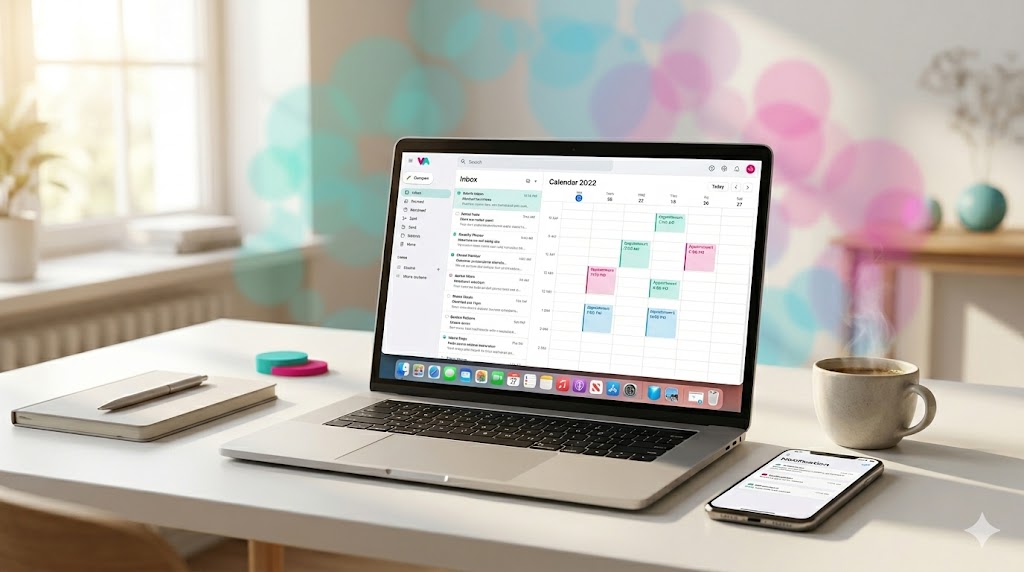
It usually starts around 7:15 in the morning. You reach for your phone before your feet hit the floor, thumb the Gmail icon out of habit, and there it is: forty-one unread messages that landed overnight. Three are from clients. One is a supplier chasing an invoice you forgot to approve. The rest is newsletters, a calendar invite that clashes with a call you already said yes to, and a “quick question” that will absolutely not be quick.
You haven’t started work yet. You’ve already lost.
For a frightening number of UK business owners, this is the actual job now. Not the thing they trained for, not the thing customers pay them for, but the relentless administration of other people’s demands on their time. The inbox and the calendar have quietly become the two organs that run the whole body, and most founders are operating them with their off-hand, half-awake, between everything else.
What follows is a close look at what that chaos costs, why the tools everyone keeps recommending don’t actually fix it, and how a trained virtual assistant — specifically a South African one working in near-lockstep with the UK day — turns the two most draining parts of running a business into something that just quietly happens in the background.
The Real Price of a Messy Inbox and a Broken Calendar
Let’s deal in numbers, because the feeling of being overwhelmed is easy to dismiss until you see what it adds up to.
The average knowledge worker now spends around 28% of the workweek on email — roughly 11.2 hours, according to McKinsey Global Institute research, with executives commonly exceeding 15 hours per week. That isn’t a typo. More than a full working day, every week, gone to reading, sorting, replying, and hunting for that one message you swear you saw on Tuesday.
The volume driving it is genuinely hard to picture. The average office worker now receives 121 emails per day while sending around 40. And it’s getting worse, not better — 73% of professionals say their email volume has grown over the past 12 months. Most of it isn’t even important. Studies show only about 30% of received emails actually require immediate action, which means the majority of those eleven hours are spent triaging noise to find the few signals that matter.
Email consumes 28% of the workweek — more than a full day, every week — and only about 30% of those messages actually require action. The rest is noise you’re paying yourself a founder’s wage to sort.
The calendar tells a similar story. Research shows the average employee spends nearly five hours per week just coordinating meetings — the back-and-forth of “does Thursday work, no how about Friday, actually can we do mornings.” And when that coordination breaks down, the cost is not just time but credibility. A double booking means missed appointments, the wasted time of rescheduling, and the damage of looking disorganised — clients hesitate to rebook or refer you.
There’s a human toll underneath the productivity numbers, too. A 2025 survey of over 6,000 knowledge workers found that 68% said email overload contributes directly to workplace stress and burnout, and 45% reported that email negatively affects their work-life balance by extending working hours into personal time. The inbox doesn’t clock off when you do. 85% of workers receive work emails, messages, or calls after hours — which is why so many founders are answering clients from the sofa at 9pm and calling it “staying on top of things.”
It isn’t staying on top of things. It’s drowning slowly while telling yourself you’re a strong swimmer.
What a VA Actually Does With Your Inbox
Handing your inbox to a virtual assistant is not the same as forwarding everything and hoping. A trained VA builds a system, and the system is the point.
The first job is triage. Your VA learns the difference between a message that needs you, a message that needs a reply but not from you, and a message that needs nothing at all. Clients and key partners get flagged and surfaced. Routine requests — booking confirmations, invoice queries, standard customer questions — get handled directly using responses you’ve approved. The newsletters and noise get filed or unsubscribed. By the time you open your laptop, the inbox isn’t a wall of forty-one unknowns. It’s a short, ordered list of the things that genuinely need your brain.
The second job is drafting and response. A good VA doesn’t just sort; they write. They reply to suppliers, chase outstanding invoices, answer common customer queries, and prepare drafts of the trickier replies for you to glance over and send. Your voice, your standards — but off your plate.
The third is maintenance. Labels stay consistent. Follow-ups don’t get forgotten. The thread you need on Tuesday is exactly where it should be because someone is actually tending the system rather than letting it silt up. Over a few weeks, your inbox stops being a source of dread and becomes something closer to a well-run reception desk: everything logged, nothing dropped, the important visitors shown straight through.
The hours this buys back are not abstract. If email is eating eleven-plus hours of your week, even halving that returns most of a working day to the work only you can do.
It helps to see it concretely. Take a typical UK consultancy founder — call her Priya. Before a VA, her morning looked like this: open the laptop, see sixty-odd unread, spend the first ninety minutes of her sharpest hours sorting wheat from chaff, fire off a few rushed replies she’d later regret, miss the supplier email entirely because it was buried under a newsletter, and start her first client call already frazzled. After a VA, the same morning is a four-line summary: two client threads needing a decision, one proposal to approve, one diary clash already resolved, everything else handled. The ninety minutes are gone — given back to the strategy work that actually grows the business. Nothing in Priya’s volume of email changed. What changed is that a trained person now stands between the flood and her attention, and only the things that need her get through.
That filtering function — the act of deciding what deserves the founder’s attention — is the single most valuable thing a VA does with an inbox, and it’s the thing no automatic rule or filter can replicate, because the decision changes with context. The email from a quiet client who suddenly sounds unhappy needs you now. The same client’s routine monthly check-in does not. A person reads the difference; a filter only reads the sender.
What a VA Actually Does With Your Diary
The calendar is where a VA quietly saves your reputation.
They own the coordination — the proposing of times, the confirming, the rescheduling when something moves. The five hours a week you’d spend playing email tennis to find a slot simply disappears, because your VA holds the full picture of your availability and negotiates on your behalf.
They enforce structure. Buffers between back-to-back calls so you’re not sprinting from one to the next. Protected blocks for the deep, focused work that never happens when your day is shredded into fragments. 58% of employees now use calendar blocking precisely because a constantly-filling calendar makes it impossible to concentrate — but blocking only works if someone defends those blocks, and that someone is usually too busy to do it. A VA defends them.
They kill the double bookings before they happen. With a single person holding a unified, real-time view of your diary, the overlaps that erode client trust stop occurring. No more two-clients-one-slot. No more apologetic 8am phone calls.
And critically for a UK business working with a South African VA, they manage time zones without you ever thinking about it — making sure the 3pm with your Manchester client and the 4pm with your contact in Dubai are both correct, both confirmed, both reminded.
A founder who reclaims the five hours a week lost to meeting coordination, plus half the eleven hours lost to email, has bought back the better part of a full working day — without hiring an employee, taking on a lease, or learning a single new piece of software.
The Human in the Loop: Why AI Tools Don’t Fix This
Here’s the objection you’re already forming: surely AI does all of this now? There’s an inbox tool that auto-labels, a scheduler that books itself, an assistant that drafts replies. Why pay a person?
Because the part that breaks your business is precisely the part AI is worst at.
Adoption is high — 36% of workers now use AI writing tools, according to Gallup’s 2025 data — yet email still feels like a grind. The reason is structural, and it’s worth understanding. As one analysis put it bluntly: most AI failures aren’t model failures, they’re context failures; large language models are powerful but fundamentally blind to decisions, relationships, history, and tone, and the messiest data in any company — email, chat, docs — is exactly where AI struggles most.
Think about what that means in practice. AI can label an email “invoice.” It cannot know that this particular supplier is the one you’re mid-dispute with, that the tone of the chasing message has shifted, that the right move is a careful holding reply rather than the auto-generated “thanks, we’ll process this shortly.” The tools handle the categories. They are blind to the judgement.
The gap shows up most where it matters: emails requiring judgement — follow-ups referencing specific conversations, outreach proving you’ve done your homework, updates synthesising multiple inputs — can’t be templated. Those are the high-stakes messages. Those are the ones that win or lose the client. And those are exactly the ones a generic tool will either fumble or hand straight back to you.
There’s a reputational risk, too. As more businesses lean on automated email platforms, a sea of uniformity forms — content lacking individuality that customers are noticing, and AI verification software increasingly flags messages that appear machine-generated, hurting deliverability. The very automation meant to save you can make your business sound like everyone else’s, or quietly land your emails in spam.
The model that actually works is the one that keeps a human in the loop. AI handles speed; the person handles judgement. A trained VA can absolutely use these tools — the auto-labeller, the scheduling link, the drafting assistant — as a force multiplier. But there is a human reading the room, catching the dispute before it escalates, noticing that the “quick confirm” is actually from your biggest account and deserves a warmer touch. The tool is the typewriter. The VA is the assistant who knows what to type.
That’s not a knock on AI. It’s just an honest account of where the line sits. For diary and inbox work, the value lives almost entirely on the judgement side of that line.
The South African Advantage: A VA Who Shares Your Working Day
If you’re a UK business, where your VA sits turns out to matter enormously — and this is where South Africa quietly beats every other option.
Start with the clock. South Africa sits at GMT+2, just two hours ahead of the UK, giving a 6–8 hour overlap every working day — real-time collaboration on Teams, Slack, and Zoom with no overnight gaps. Compare that to the Philippines or India, where VAs face a 7–8 hour timezone gap with London, forcing either night-shift work, which degrades quality, or asynchronous message chains that stretch simple tasks across days. For inbox and diary work — which is inherently real-time, reactive, happening now — that overlap is the whole game. Your VA is triaging this morning’s emails while it’s still this morning, not flagging them for you to find tomorrow.
One UK operations director described the contrast precisely after switching from an Asian provider: the eight-hour time difference meant their assistant was starting work as the team was finishing, so simple tasks stretched across days — whereas with a South African team, overlapping hours made same-day completion standard rather than exceptional.
South Africa sits two hours ahead of the UK with no overnight gap. Your VA is clearing this morning’s inbox while it’s still this morning — not queueing it for you to discover at dawn tomorrow.
Then there’s language, which for client-facing inbox work is non-negotiable. English is spoken natively or near-natively by 95% of South African professionals, producing neutral accents British clients find familiar rather than foreign. More than accent, it’s the style: South Africa’s business education emphasises Western communication norms — direct but polite, hierarchical yet collaborative, results-focused while relationship-aware. When your VA replies to your UK customers in your name, they sound like you, not like a translation.
And the economics are, frankly, hard to argue with. The Rand-to-Dollar exchange rate makes South African professional services 40–60% cheaper than UK or US equivalents — but, critically, without the competency gap that accompanies the cheapest Philippine or Indian pricing. The hard-won lesson of the outsourcing market over the last few years, as one industry analysis put it, is that in knowledge work, cheap is expensive — you get what you pay for, and task completion is not the same as strategic partnership.
The timezone alignment isn’t just a convenience, either; it’s measurable output. Oxford Economics estimates that timezone-aligned outsourcing reduces project completion times by 31% compared to Asian alternatives. For diary and inbox management, where the value is in same-day turnaround, that’s the difference between a VA who keeps you ahead and one who keeps you waiting.
In knowledge work, cheap is expensive. A VA who saves you 40% on cost but loses a day on every task — and fumbles the messages that win clients — isn’t a saving. It’s a slower, riskier version of the problem you started with.
It’s worth being precise about why the South African fit is so specific to UK businesses rather than a generic “offshore” pitch. The morning overlap means your VA is online and reactive during the exact window your UK day is busiest — the 8am-to-2pm stretch when client requests, diary changes, and urgent emails actually arrive. There’s no daylight-saving drift to manage; the gap stays a steady two hours year-round. And because the cultural and linguistic alignment is so close, the onboarding friction that plagues distant outsourcing — the constant re-explaining, the tonal misfires, the “that’s not quite what I meant” — largely disappears. You’re not bridging a gap. You’re working with someone who already operates the way your market expects.
Managed, Not Matched: Why the Model Behind the VA Matters
Here is the part most businesses learn the hard way. You can find a freelancer in an afternoon. Keeping inbox and diary management reliable over years — through holidays, illness, the day your VA’s wifi dies, the week they’re swamped — is a different problem entirely. And that’s the problem a freelancer marketplace doesn’t solve.
This is the gap between hiring a person and using a managed service. With a freelance VA pulled off a platform, you are the recruiter, the trainer, the quality control, the backup plan, and the HR department. When they vanish, your inbox vanishes with them — and with it, the institutional memory of how your business actually runs.
The managed model flips that. Every VAConnect assistant is recruited through VAJobs, trained on VAVarsity, monitored through Atomic Energy, and accountable through VAPIness — you get the output, and the agency handles the infrastructure. Your VA arrives already trained on the platforms UK businesses rely on — Xero, HubSpot, Slack, Asana, Microsoft 365, Google Workspace, and more. There’s no agency temp roulette, and if continuity is ever at risk, the structure behind your VA is designed to keep your inbox and diary running regardless.
For the two functions we’re talking about — the inbox that cannot go dark for a week, the calendar that must not drop a client meeting — that continuity is not a nice-to-have. It’s the entire reason the managed model exists.
The cost comparison makes the choice sharper still. A full-time dedicated VAConnect VA starts from around $1,088/month (roughly £860), against £2,900+/month for a UK-based PA before you add employer National Insurance, pension contributions, and office costs. You’re not buying a cheaper version of an employee. You’re buying a more reliable version of the outcome, at a fraction of the all-in cost.
How the Handover Actually Works in the First Two Weeks
One reason founders cling to their own inbox long past the point of sanity is fear of the handover itself. It feels like it’ll be more work to explain everything than to just keep doing it. That instinct is understandable — and, with the right model, wrong.
A good handover doesn’t start with access. It starts with a conversation about how you actually work: which clients are sacred, which senders can wait, what your reply to a late payment sounds like versus your reply to a warm referral, how you like your diary to breathe. In the first few days, your VA shadows rather than acts — drafting replies for your approval, proposing diary changes for your sign-off, learning the texture of your business by watching you respond. You’re not writing a manual. You’re letting someone observe, the way a new senior hire would in their first week.
By the end of week one, the patterns emerge. Your VA knows that emails from a certain account always jump the queue, that you protect Tuesday and Thursday mornings for deep work, that you’d rather over-confirm a meeting than risk a no-show. By week two, the approvals thin out. The routine replies go without your sign-off because they’re indistinguishable from what you’d have written. The diary runs itself. What started as supervised drafting becomes genuine delegation — and the founder who was terrified of the handover realises they’ve stopped checking.
The managed model matters enormously here, because this learning isn’t lost the moment one person is unavailable. The standards, preferences, and approved responses live in a system, not just in one VA’s head — which means continuity survives a sick day, a holiday, or a handover to backup cover. Compare that to a solo freelancer, where everything you patiently taught them walks out the door the day they do.
A reasonable rule of thumb: by the thirty-day mark, a well-run inbox-and-diary handover should have moved from “I’m explaining everything” to “I barely think about it.” If it hasn’t, the problem is usually the model — an untrained freelancer with no system behind them — rather than the idea of delegation itself.
Picture the same 7:15am, three months after you’ve handed the inbox and diary over.
You reach for your phone — old habit — but there’s less reason to. Your VA, two hours into their South African morning, has already worked through what landed overnight. The supplier invoice has a draft reply waiting your nod. The calendar clash has been resolved and both parties reconfirmed. The newsletters are filed. What’s left when you open your laptop is a short, honest list of the things that actually need you, and a calendar with breathing room built into it on purpose.
The eleven hours of email and the five hours of scheduling that used to be your week are now somebody else’s craft — done in real time, in your voice, by a trained professional who shares your working day. You’ve stopped being the bottleneck in your own business.
That’s the gap that has opened up. On one side, founders still triaging forty-one emails before breakfast, playing calendar tennis between meetings, sounding the alarm over a double booking they spotted ten minutes too late. On the other, businesses that simply stopped doing this themselves — and got their best working hours back.
The widening distance between those two groups is genuinely striking. The work hasn’t changed. Who’s doing it has.
DIY vs Generic Freelancer vs VAConnect: The Honest Comparison
| Factor | DIY (You Do It) | Generic Freelancer / AI Tool | VAConnect Managed VA |
|---|---|---|---|
| Email triage | 11+ hrs/week of your own time | Inconsistent; tool labels but can’t judge | Trained triage in your voice, judgement included |
| Time zone fit (UK) | N/A — it’s your time | Often 7–8 hr gap (Asia); tasks slip to next day | GMT+2, 6–8 hr daily overlap, same-day turnaround |
| Calendar coordination | ~5 hrs/week lost to back-and-forth | You still manage the manager | Fully owned, buffers and focus blocks defended |
| Double-booking risk | High — you’re distracted | Moderate; depends on the individual | Low — single real-time view of your diary |
| English & UK tone | Yours | Variable; accent and style mismatch common | Native-level, British-aligned communication |
| Handles judgement calls | Yes, but it’s costing you | No — AI is blind to context and relationships | Yes — human in the loop directing the tools |
| Continuity if VA is off sick | You’re the backup | None — they vanish, your inbox vanishes | Managed cover and backup built in |
| Training on your tools | N/A | Your job to onboard them | Pre-trained on Xero, HubSpot, M365, Slack, Asana |
| Monthly cost | “Free” (your founder hours) | Cheap up front, expensive in errors | From ~£860/mo, all infrastructure included |
| What you’re really buying | More overwhelm | Task completion, maybe | A reliable outcome and your week back |
The inbox and the calendar are not glamorous. Nobody started a business to become a world-class triager of their own email. But these two functions, left to run themselves, quietly set the ceiling on everything else you’re trying to build — because every hour spent here is an hour not spent on the work only you can do.
Handing them to a trained South African VA who shares your working day isn’t outsourcing a chore. It’s reclaiming the part of your week that was never supposed to belong to your inbox in the first place.
Ready to get your mornings back? Book a 30-minute discovery call and we’ll match you with a dedicated VA who shares your working day, speaks your language, and is built to stay.