
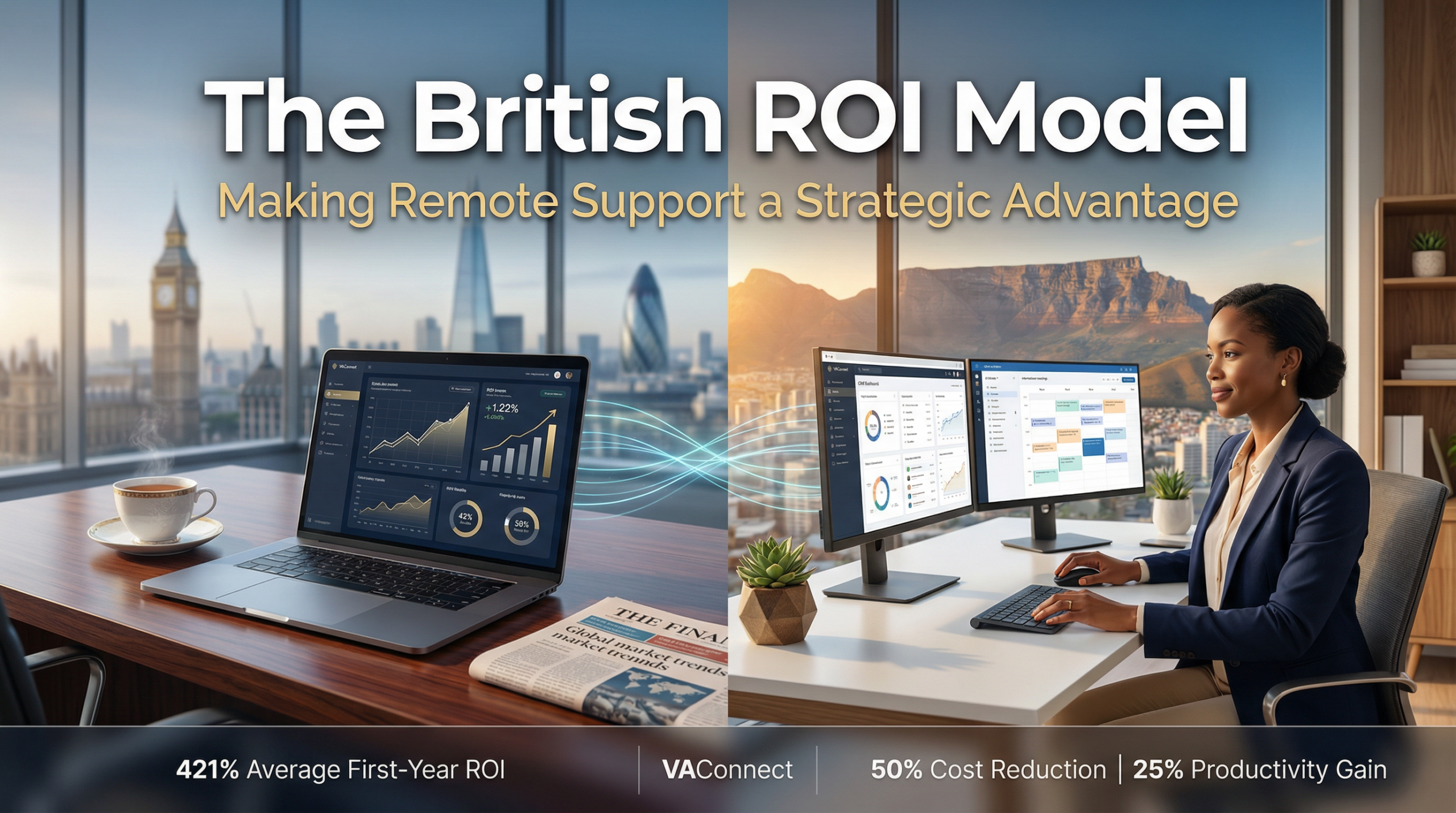
The British ROI Model: Making Remote Support a Strategic Advantage
It usually starts on a Tuesday. A UK founder opens her laptop to forty-one unread emails, three of which actually matter. Her calendar is a wall of back-to-back calls, two of which exist only because nobody wrote a one-paragraph update instead. A client wants a proposal “by end of day.” The bookkeeping is two weeks behind. Someone needs to chase an invoice, reschedule a meeting that’s already been rescheduled twice, and find out why the new starter never got their onboarding pack. None of this is the actual business. All of it is in the way of the actual business.
This is the quiet crisis inside thousands of British small and mid-sized companies right now. Not a lack of talent or ambition, but a slow strangulation by coordination. The work about the work has swallowed the work itself. And the strange part is how normal it has become to accept it, to treat a 55-hour week of admin-padded chaos as the cost of running something.
It doesn’t have to be. The data from the last two years tells a story that should genuinely unsettle anyone still trying to hold it all together alone, because the gap between businesses that have solved their coordination problem and those still drowning in it has grown far wider than most owners realise. This is a look at why that gap exists, what the research says about remote support actually working, and why a specific model — South African talent placed by agencies like VAConnect — has turned into one of the more lopsided advantages available to a British business in 2026.
The Hidden Tax Nobody Puts on the Balance Sheet
If you want to understand why so many capable people feel underwater, start with meetings. In 2024, Atlassian surveyed 5,000 knowledge workers across four continents and found something close to a consensus: meetings were the single biggest waste of their time. According to that research, roughly 72% of meetings were judged ineffective at sharing information or getting things done — three in four sessions that could have been a short written update. Nearly 78% of respondents said the sheer number of meetings made it hard to finish their actual work, and more than three-quarters reported feeling drained on meeting-heavy days. (Atlassian, reported by Fortune, 2024)
The lived version of this is worse than the statistic. On the workplace forum Teamblind, one engineer described spending 16 of every 40 hours in meetings, forcing themselves to stay alert in case a question landed, dreading the next call before the current one ended. The replies were not sympathy so much as recognition — and grim one-upmanship from people whose calendars were even worse. (Teamblind discussion)
Three in four meetings were judged completely ineffective — and 78% of workers said the volume of them made it genuinely hard to do their jobs.
What both the survey and the forum thread point to is a tax that never shows up in the accounts. You don’t get an invoice for the hour spent rescheduling a call, or for the focus that evaporates when your day is sliced into fragments too small to think in. But it is real money. When a founder bills at £150 an hour and spends ten hours a week on inbox triage, diary management, and follow-ups that a competent assistant could handle, that’s £78,000 of annual capacity quietly set on fire. The business doesn’t fail dramatically. It just never quite gets off the runway, because the person who’s supposed to be flying it is busy refuelling, checking tickets, and mopping the cabin floor.
What the Research Actually Says About Remote Output
For years the objection to delegating work to someone you can’t see across the room was a gut feeling: surely people are less productive when they’re not in front of you. The most rigorous study yet on the subject puts that instinct under real pressure.
In June 2024, Stanford economist Nicholas Bloom and his co-authors published a randomized controlled trial in Nature — the gold standard of evidence, and rare in this field. They followed 1,612 employees at Trip.com over six months. Workers who shifted to a hybrid schedule were just as productive and just as likely to be promoted as their fully office-based peers, while resignations among them fell by about a third. Crucially, the managers in the study had predicted that remote days would damage output. By the end, having watched the actual results, they had changed their minds. (Bloom et al., Nature, 2024; summarised by Stanford SIEPR)
“The results are clear: Hybrid work is a win-win-win for employee productivity, performance, and retention.” — Nicholas Bloom, Stanford economist
Bloom went further in a 2024 piece for the IMF, arguing that the fivefold increase in remote work since the pandemic could meaningfully lift economic growth rather than drag on it. (IMF Finance & Development, 2024) The point worth sitting with is the direction of the surprise. The skeptics expected remote work to cost them. The measured outcome was that it didn’t — and in retention terms, it paid. Managers were wrong in a specific, repeatable way: they trusted the feeling of supervision more than the evidence of results.
That matters for any owner deciding whether to hand off real responsibility to a remote assistant. The fear that “they won’t work as hard if I can’t see them” is exactly the fear that the best available study dismantled. Output is measurable. Presence is theatre. Once you stop paying for theatre, the maths changes fast.
Why “Just Hire a Freelancer” Quietly Fails
Plenty of business owners have already worked out that they need help. So they post a gig, hire the cheapest capable-looking freelancer on a marketplace, and feel briefly clever. Then, three weeks later, they’re managing the freelancer more intensively than they ever managed the task. This is one of the least discussed traps in delegation, and it deserves blunt language.
A generic freelancer is optimised for transactions, not relationships. They’re juggling six other clients, they bill by the deliverable, and they have no structural reason to learn how your business actually works. You explain the same context every time. The work technically meets the brief and somehow still misses the point. When someone goes quiet for a week, there’s no agency standing behind them to catch the gap. And the timezone roulette of a global marketplace means your “urgent by Tuesday” might land with someone whose Tuesday morning is your Monday midnight.
The deeper problem is that coordination overhead doesn’t disappear when you hire this way — it just moves. You’ve swapped doing the task for managing the person doing the task, and if the management cost is high enough, you’ve gained almost nothing. The promise of cheap freelance labour runs straight into the reality that the expensive part was never the labour. It was the trust, the context, and the reliability. Those don’t come à la carte.
This is the gap that managed virtual assistant agencies set out to close, and it’s worth being precise about the difference. A managed agency isn’t a marketplace that takes a cut. It vets the talent before you ever meet them, handles the employment and compliance burden, provides cover when your assistant is ill, and — most importantly — places someone who is meant to stay. The relationship is the product. The single task is just the first of thousands.
The Human in the Loop: Why a VA Beats Pure AI Automation
It would be reasonable, in 2026, to ask why any of this needs a human at all. The tools are extraordinary. A large language model can draft your emails, summarise your meetings, and clear your inbox in seconds. Surely the smart move is to automate the coordination problem out of existence and skip the headcount entirely.
This is where a lot of businesses are quietly getting it wrong, and the reason is subtle. AI is a phenomenal drafter and a dangerous decider. It will produce a confident, fluent, plausible answer to almost anything — including the things it has no business answering. It doesn’t know that this particular client hates exclamation marks, that the invoice chase to your biggest account needs a softer tone, that the “urgent” request from a junior contact can wait but the casual one from the founder cannot. It has no stake in the relationship and no memory of the politics. Left fully in charge, it generates output that is grammatically immaculate and contextually tone-deaf — the written equivalent of a smile with nothing behind it.
What works is not AI instead of a person, and not a person ignoring AI. It’s a person operating AI with judgment. VAConnect’s own description of how it runs is unusually honest about this. Their assistants are encouraged to use AI tools — drafting research with a chatbot, editing with Grammarly, generating image concepts — but the human stays the conductor. The company gives a concrete example: a UK accountancy firm’s blog post on tax-loss harvesting gets drafted by AI, then rewritten by an assistant who understands that British readers need far more context about Capital Gains Tax than a generic model supplies. (VAConnect, 2026)
AI is a brilliant drafter and a terrible decider. The value isn’t the tool or the person — it’s the person holding the tool with judgment the machine can’t fake.
That last word — context — is the whole game in client communication. The reason a real assistant beats pure automation isn’t nostalgia for human touch. It’s that the costliest mistakes in business are mistakes of judgment, not grammar. A model will happily send the technically correct message that loses you a client. A good human in the loop catches it because they actually understand what’s at stake, and because they’ve absorbed the thousand small preferences that make your communication sound like you rather than like everyone. Humanising your content and your client contact isn’t a soft nicety. In a market where customers are increasingly drowning in obviously machine-generated outreach, sounding like a real, attentive person has quietly become a competitive edge — and it requires a real, attentive person to maintain it.
The businesses winning right now aren’t the ones that automated their humans away. They’re the ones that pointed a sharp human at the right AI tools and let them move three times faster without losing the judgment that protects the relationship.
The South African Advantage Nobody Saw Coming
Here is where the story takes a turn that genuinely surprised the UK market. If you’re a British company sold on the idea of remote support and looking past your own borders for value, the obvious instinct is to look toward the traditional offshoring destinations. The data, and a growing number of UK firms, suggest you should be looking at South Africa instead — and the reasons compound in a way that’s hard to argue with once you see them laid out.
Start with the clock. South Africa runs on GMT+2, which means one to two hours ahead of the UK depending on the season. That is not a “we’ll catch up tomorrow” relationship; it’s a genuinely overlapping working day. A London director can hand off work at 5pm, walk away, and find it done by the time they open their laptop at 8:30 the next morning, while the assistant has worked an ordinary 9-to-5 in Cape Town. No graveyard shifts. No “sorry, I was asleep when your message came in.” VAConnect reports that in a 2024 internal audit of 312 Birmingham businesses, 87% cited timezone practicality as either important or critical to choosing South African talent over Asian alternatives. (VAConnect, 2026) That overlap turns a remote assistant from an overnight outsourcer into something much closer to a colleague who happens to work from another city.
Then there’s language and culture. South Africa has a large pool of native-level English speakers raised on British spelling conventions, British media, and a business culture with deep historical and commercial ties to the UK. The difference shows up in the small things that decide whether client-facing work lands — the ability to pitch a tone correctly, to know which phrasing reads as professional versus pushy, to write a message a British reader experiences as natural rather than slightly off. VAConnect describes screening for what it calls “commercial empathy”: can a candidate intuit why a UK financial adviser might avoid certain marketing phrases that would land fine in Cape Town? That’s not a skill you can fake, and it’s not evenly distributed across the global talent map.
And then the cost. This is the part that produces the double-take. Reporting on the South African market puts labour costs roughly 30–40% below UK or US equivalents, against a workforce with comparable — often superior — English fluency and cultural alignment. (VirtualAssistant.co.za, 2026) VAConnect’s own figures for UK clients put the saving as high as 50–70% once you account for the on-costs a British employer never has to carry — no PAYE, no employer National Insurance, no pension auto-enrolment admin, because the agency holds the employment relationship. (VAConnect, 2026)
A London business can hand off work at 5pm and have it finished by 8:30am — at 30 to 50% of UK cost — without anyone working a night shift. That combination didn’t used to exist.
The thing that should give a UK business owner pause is that these factors don’t add up — they multiply. Cheap-but-incompatible (wrong timezone, weak English, no cultural fit) is a false economy you’ve all seen fail. Compatible-but-expensive is just hiring locally. South Africa sits in the rare quadrant where the price is low and the fit is high and the clock cooperates. That quadrant is mostly empty, which is exactly why the companies that found it early are pulling away.
Inside the Model: How VAConnect Actually Places Talent
It’s one thing to say a country has the right raw ingredients. It’s another to turn that into reliable support a business can build on, and the operational details are where the better agencies separate themselves from the marketplace free-for-all.
VAConnect has been doing this since 2008, which in an industry full of pandemic-era startups is a meaningful track record. The company reports having placed more than 2,400 South African virtual assistants with UK-based clients since 2019, with Birmingham alone accounting for around 34% of its British portfolio — a concentration that suggests word-of-mouth doing its work in a specific business community. (VAConnect, 2026)
The model rests on a few deliberate choices. Assistants are vetted and skill-tested before a client meets them, rather than self-certified on a profile page. They’re trained on the tools UK businesses actually run — Xero, HubSpot, Monday.com, Microsoft 365 — so the first week isn’t lost to software archaeology. The agency carries the employment and compliance load, meaning a UK firm gets the output without becoming a cross-border employer. And there’s an emphasis on retention that runs against the churn-heavy norm of the freelance economy. The company runs an internal academy (it calls it VAVarsity) to keep assistants upskilling, and the founder is unusually blunt about what she’s optimising for.
“I don’t want to be the biggest VA company. I want to be the one where nobody leaves — not the clients, and not the VAs.” — Karen, VAConnect founder
That sentence is worth more scrutiny than a typical founder quote, because it describes a genuinely different incentive. A marketplace makes money on volume and transactions; churn is fine, even useful, because there’s always another gig. An agency built around nobody leaving has to solve the harder problem — making a remote working relationship durable enough that a client stops thinking of their assistant as a vendor and starts thinking of them as part of the team. When that works, the coordination overhead that wrecks the freelancer model collapses, because context accumulates instead of resetting every few weeks.
This is also where the human-in-the-loop philosophy and the South African advantage meet. You can’t extract “commercial empathy” from someone in a six-week engagement; it’s a property of a long relationship with a person who’s invested in getting your business right. The retention focus isn’t a soft value statement. It’s the mechanism that makes the rest of the model pay off.
The Compounding Gap: What This Looks Like Over a Year
Step back from any single task and the real story is about accumulation, because the difference between solving your coordination problem and merely surviving it doesn’t stay constant — it widens.
Consider two near-identical UK firms. Both have a founder worth £150 an hour doing the actual high-value work. Firm A keeps grinding through admin alone, losing roughly ten hours a week to coordination it shouldn’t be touching. Firm B places a dedicated assistant at, say, a fraction of a UK salary, hands off the inbox, the diary, the invoicing chases, the social posts, and the first drafts.
In week one, the difference is modest — Firm B has spent a little money and freed a little time. But the gap compounds. Firm B’s founder now has those ten hours a week pointed at sales, product, and clients — the things that actually grow a business. Over a year that’s roughly 500 reclaimed hours of the most valuable labour in the company. Meanwhile the assistant is getting better: learning the clients, anticipating the rhythms, catching the things before they become fires. Firm B’s communication gets more responsive, not less, because there’s now a human whose whole job is to keep the relationship warm. Firm A’s founder, a year on, is exactly where they started, only more tired, having spent the year refuelling the plane instead of flying it.
The Bloom research tells us the remote output is real. The Atlassian data tells us the coordination tax is real. The South African model tells us the fit and the price can both be right at once. Put those together and the conclusion is uncomfortable for anyone still going it alone: the businesses that solved this aren’t a little ahead. They’ve been compounding an advantage every single week while their competitors treated exhaustion as a personality trait.
The broader market seems to agree about the direction. Analysts tracking the global virtual assistant services sector — the human kind, not the AI-software kind — put it at around USD 18 billion in 2024 and growing through the rest of the decade, driven by exactly this shift toward agency-managed teams and hybrid human-plus-automation models. (Future Market Insights, 2025) The demand isn’t a fad. It’s businesses working out, one stressed founder at a time, that the coordination problem has a solution and that solving it is no longer optional if you intend to compete.
The Competitive Gap, Stated Plainly
Here’s the thing that should genuinely give a UK business owner a jolt. None of the pieces in this story are secret. The Bloom study is in Nature. The Atlassian numbers were in Fortune. The cost and timezone facts about South Africa are sitting on public pages. And yet the gap between the firms acting on all of this and the firms still drowning in their own inboxes keeps widening, because information being available is not the same as it being acted on.
The competitive gap, stripped of all the framing, comes down to this: one set of businesses has decided that the work about the work is somebody’s full-time job, and has found a way to staff it with a real, judgment-carrying human who shares their working day, speaks their language, costs a fraction of a local hire, and stays long enough to actually understand the business. The other set is still treating coordination as a tax they have to personally pay in hours and sanity, while telling themselves they’ll fix it “once things calm down.” Things do not calm down. That’s the whole point of the trap.
The research is settled enough, the model is mature enough, and the maths is lopsided enough that hesitation is now the expensive choice. The British ROI model isn’t about cutting costs. It’s about pointing your most valuable hours at the work only you can do, and trusting a capable human — armed with the right tools and the right context — to handle everything else. The firms that figured this out aren’t working harder than you. They just stopped doing the work that was never theirs to do in the first place.
How the Three Approaches Actually Compare
| Dimension | DIY Coordination | Generic Freelancer | VAConnect Model |
|---|---|---|---|
| Founder’s high-value hours reclaimed | None — you are the coordination | Some, offset by management time | High — work is genuinely off your plate |
| Time-zone overlap with UK | N/A (it’s you) | Roulette — global marketplace, no guarantee | Strong — GMT+2, real overlapping workday |
| Context & relationship continuity | Total, but trapped in one head | Low — resets per gig, juggling many clients | High — placed to stay; context compounds |
| English & cultural fit for UK clients | Native | Variable, often a poor match | Native-level, British-English, UK business culture |
| Reliability & cover if someone’s unavailable | Everything stops | None — freelancer goes quiet, you’re stuck | Agency-backed cover and accountability |
| Use of AI | Ad hoc, no judgment layer | Inconsistent | Human-in-the-loop: AI drafts, person decides |
| True cost | Hidden — paid in your own hours & burnout | Cheap per task, expensive in management overhead | 30–70% below UK hire, on-costs handled by agency |
| Employment / compliance burden | N/A | Yours to figure out | Carried by the agency — no PAYE, NI, or pension admin |
| Trajectory over 12 months | Flat — same chaos, more fatigue | Flat to marginal | Compounding — assistant gets better, gap widens |
Sources referenced
- Academic: Bloom, N. et al. (2024), randomized controlled trial on hybrid work, published in Nature; summarised by Stanford SIEPR and the IMF.
- Industry report: Future Market Insights — Virtual Assistant Services Market (2025); meeting-productivity research via Atlassian, reported by Fortune (2024).
- Forum / social sentiment: Teamblind discussion on meeting burnout.
- Interview / leadership quote: Karen, VAConnect founder, VAConnect; Nicholas Bloom, Stanford SIEPR.
- VAConnect-specific data: placement, timezone-audit, vetting and cost figures from VAConnect UK, VAConnect SA, and VirtualAssistant.co.za.
Note: figures attributed to VAConnect and its associated sites are drawn from the company’s own published materials and internal audits, and are presented as such.