
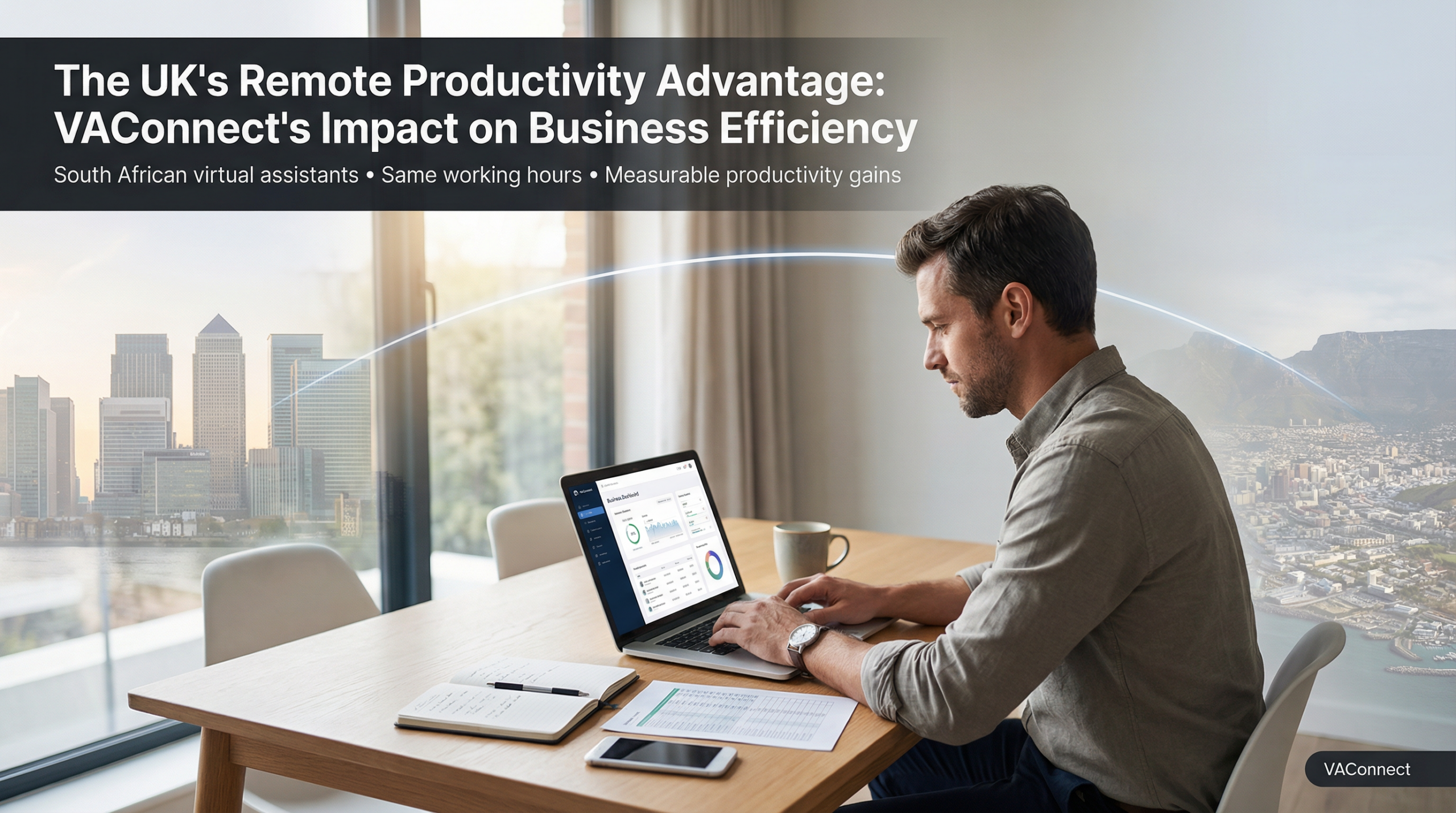
The UK’s Remote Productivity Advantage: VAConnect’s Impact on Business Efficiency
It usually starts on a Tuesday morning. A founder opens their laptop to fourteen unread Slack threads, a calendar carved into seven back-to-back calls, three half-finished proposals, and an inbox where two suppliers, a prospective client, and the accountant are all waiting on a reply that should have gone out yesterday. None of it is hard. That’s the maddening part. Each task takes four minutes. There are just ninety of them, and they keep arriving faster than anyone can clear them.
This is the quiet productivity crisis sitting underneath most small and mid-sized British businesses right now. Not a shortage of ambition or talent, but a shortage of coordinated hands. The work that actually moves a company forward — closing deals, building product, talking to customers — keeps getting buried under the work of running the work. And the data suggests British firms are losing this fight badly, often without realising how far behind they’ve fallen against competitors who solved the problem.
That solution, increasingly, is sitting about 6,000 miles south, one hour ahead of London, working a normal nine-to-five and speaking fluent English. The shift toward South African virtual assistants — and toward agencies like VAConnect that have built an entire operating model around it — has moved from a fringe cost-saving trick to something closer to a structural advantage. The gap between firms using it well and firms still trying to do everything themselves has become genuinely difficult to explain away.
The Real Cost of Coordination Chaos
Let’s be precise about what’s actually being lost, because “I’m busy” is not a number a CFO can act on.
Start with meetings, the most visible symptom. A 2024 study by Australian software firm Atlassian surveyed 5,000 knowledge workers across four continents and found that meetings are ineffective at sharing information, encouraging collaboration, and getting things done roughly 72% of the time. Nearly four in five respondents — 78% — said they struggle to finish their actual work because of how many meetings they’re expected to attend each week. More than half were working overtime specifically to recover the hours meetings ate.
The financial figure is sharper still. Separate research from Software Finder put the cost of unnecessary meetings at $6,280 per worker per year, rising to nearly $10,000 for technical staff who lose around 169 hours annually. Seventy-two percent of workers in that survey reported outright “meeting fatigue,” with younger employees feeling it most acutely.
Three out of four meetings could have been an email. The average worker loses over $6,000 a year sitting in the other three.
But meetings are only the part you can see on a calendar. The deeper drain is the invisible administrative residue: chasing invoices, reformatting decks, scheduling across time zones, updating the CRM, replying to the fifth “just circling back” email of the day. This is the work that doesn’t show up in any planning document yet consumes the bulk of a founder’s week. On forums where this gets discussed candidly — a recurring theme across Hacker News and product-management communities — the same confession appears again and again: the only time left for real work is after everyone else has logged off. One product manager described coaching someone whose meeting load meant their only focused hours came after midnight. That isn’t a scheduling problem. It’s a structural one.
Microsoft’s own analysis of more than 31,000 workers landed in the same place: inefficient meetings and sheer meeting volume rank as the single biggest workplace distraction. When that much of the working week is consumed by low-value coordination, the question stops being how do we run better meetings and becomes who is supposed to be catching all the rest of this.
What gives this its particular flavour in 2026 is that the workday no longer has edges. The phenomenon now has a name — the “infinite workday” — and it describes exactly what founders describe: a day that fragments into peaks scattered from early morning to late evening, with the supposed downtime in between filled by the admin that never got cleared. The boundary between work and not-work didn’t just blur; for a lot of small-business owners it dissolved entirely. There’s no commute to mark the end, no office to leave. There’s just the laptop, and the laptop never empties. People aren’t necessarily working more hours that feel productive. They’re working more hours that feel like triage.
For most UK small businesses, the honest answer is nobody. The founder catches it. Then the founder burns out.
Why “Just Hire Someone” Stopped Working
The obvious fix — hire an assistant — collides with British employment maths. A competent UK-based personal assistant or office manager now costs upward of £2,900 a month before you add employer National Insurance, pension auto-enrolment, holiday cover, and the desk they sit at. For a company doing £400,000 in revenue, that’s a serious line item to justify for work that is essential but rarely revenue-generating on its own.
So firms do the thing that feels responsible and try to absorb it. They lean on software. They buy another SaaS subscription that promises to automate the chaos, then spend an afternoon a week maintaining the automation. They push the overflow onto existing staff, who quietly start hating their jobs. Or they turn to generic freelance marketplaces, hire the cheapest available bidder, and discover that low cost and low friction are not the same thing — every task needs re-briefing, quality swings wildly, and the freelancer juggling eleven other clients vanishes for three days when you need them most.
The result is a kind of expensive standstill. The business is paying — in salary, in software, in founder hours, in turnover — but it isn’t buying genuine leverage. And leverage is the whole point.
The South African Advantage
Here is where the geography starts to matter in a way that sounds almost too convenient until you look at the numbers.
South Africa sits in the GMT+2 zone, which means it runs one to two hours ahead of the UK depending on the season. For a British business, this is close to the ideal offset. There’s a full, overlapping morning window for live conversation and handoffs, followed by hours of asynchronous coverage while the UK team gets on with deep work. A marketing director in Birmingham can assign a task at five in the afternoon, switch off, and find it finished by half past eight the next morning — and crucially, the person who did it worked a normal Cape Town day, not a punishing graveyard shift. That difference shows up in retention and quality in ways the cheaper Asian time zones, often eight or more hours out, simply can’t match. In VAConnect’s 2024 internal audit of 312 Birmingham clients, 87% cited timezone practicality as either “important” or “critical” to choosing South African talent over alternatives.
Then there’s language and culture. South Africa’s business language is English, and not English as a learned second tongue but as the everyday medium of commerce, law, and media. VAConnect specifically matches UK-facing roles with assistants fluent in British English conventions and familiar with how British clients actually communicate — the indirectness, the understatement, the difference between “interesting” and interesting. There are no accent barriers on a client call, no scripts, no awkward translation layer between your brand and your customer.
A full-time South African VA runs from around £860 a month. The UK equivalent starts north of £2,900 — before NI, pension, and the office chair.
The cost story is the part that makes people do a double-take, but it’s the combination that’s striking. VAConnect operates what amounts to a parallel labour market at a 60–75% discount to UK rates while matching, and frequently beating, domestic quality benchmarks. A dedicated full-time VA starts at roughly $1,088 a month, about £860 — and that figure already includes the recruitment, training, and management infrastructure, with no PAYE, no employer NI, and no pension admin landing on the client.
What makes the talent genuinely strong rather than merely cheap is supply. Cape Town and Johannesburg together produce around 14,000 university graduates a year in business administration, communications, and digital marketing — into a job market with formal capacity for fewer than 40% of them. That’s a deep pool of highly educated, underemployed professionals. An agency that recruits on rejection rates rather than acceptance thresholds can be genuinely selective. The arbitrage isn’t squeezing desperate workers; it’s connecting skilled people to work that matches their training, on a clock that suits both sides.
This is why the UK virtual assistant market — worth £773 million in 2024 and projected to reach £4.3 billion by 2030, a 33.9% compound annual growth rate — is increasingly being captured by South African providers rather than the traditional offshore destinations. The fundamentals line up almost suspiciously well.
It’s worth dwelling on why the older offshore playbook keeps losing this comparison. The first wave of business outsourcing optimised almost entirely for cost, which pushed work toward whichever location was cheapest regardless of fit. That produced the familiar frustrations: support staff working through the small hours to overlap with Western clients, cultural reference points that didn’t translate, and a constant low-grade friction on every interaction. South Africa changes the maths because it doesn’t force a trade-off between affordability and fit. The country shares a legal and commercial heritage with the UK, watches a lot of the same media, and operates on a business culture that British clients recognise instantly. Add the near-identical clock and the result is an assistant who feels less like a distant contractor and more like a colleague who happens to work from a sunnier office. VAConnect has leaned into this so heavily that 34% of its UK client base sits in a single region around Birmingham — a corridor of repeat business and referral that only forms when the experience consistently delivers.
The Human in the Loop: Why a Person Still Beats the Bot
There’s an obvious objection hanging over all of this in 2026: why hire a human at all when AI can draft the email, summarise the meeting, schedule the call, and write the social post for free?
It’s a fair question, and the honest answer is that AI handles a real and growing slice of this work. But the evidence on what happens when companies try to hand the whole job to automation is sobering. Oxford Economics’ 2025 Enterprise AI Maturity Index, built on a survey of nearly 4,500 executives worldwide, found that overall AI maturity scores actually declined year-on-year, with only a small group of “Pacesetter” companies extracting real economic value. The tools are powerful. Most organisations are not getting the promised return because the missing ingredient isn’t the model — it’s the judgement wrapped around it.
That judgement is what a virtual assistant supplies, and it’s worth being specific about what it actually does. A model can generate a perfectly grammatical follow-up to a client who’s gone quiet. It cannot tell you that this particular client went quiet last time because they were embarrassed about a late payment, and that the right move is a warm, low-pressure check-in rather than the chasing tone the template defaults to. A human VA who has handled your inbox for six months knows that. They carry context the model doesn’t have and can’t infer.
The same gap shows up in content. AI-written posts, mass-produced and unedited, have flooded every feed to the point of reader exhaustion. The thing that cuts through now is the opposite: writing that sounds like an actual person made specific choices. A VA doesn’t just press generate. They take the raw AI draft, strip out the tells, add the detail only someone inside the business would know, adjust the tone to the specific reader, and decide what not to send. The most effective setups aren’t human or AI. They’re a person using AI as a power tool — drafting fast, then applying the judgement, taste, and relationship memory that automation has no access to.
AI can write the message. It can’t know that this client needs reassurance, not a reminder. The judgement is the job.
One agency operations lead put the distinction bluntly when describing why clients who arrive wanting to “replace staff with AI” almost always end up wanting a person who uses AI: “The model is brilliant at the first 80% and dangerous in the last 20%. It writes a great draft and then makes one confident error that costs you a client. You need someone who knows which 20% to never trust.” That instinct — knowing where the tool stops being reliable — isn’t something you can prompt into existence. It’s earned through context and judgement.
There’s also the simple matter of trust and accountability. When something goes wrong — a deadline slips, a client is upset, a number doesn’t add up — you need someone who can own it, investigate it, and fix it, not a tool that confidently produced the error and moved on. The companies pulling ahead aren’t the ones who automated the most. They’re the ones who kept a capable human in the loop and gave that human better tools. VAConnect’s assistants arrive already trained on the platforms British firms run on — Xero, HubSpot, Slack, Asana, Microsoft 365, Google Workspace — and on how to use AI as an accelerant rather than a replacement for thinking.
What the Research Actually Says About Remote Work
The skeptic’s reflex is that remote workers, especially offshore ones, must be less productive. The opposite turns out to be true, and the most rigorous study on the subject is worth knowing.
Stanford economist Nicholas Bloom, working with Han and Liang, ran a large-scale randomised field experiment published in Nature in 2024. Employees were assigned to either full-time office work or a hybrid arrangement of three office days and two at home. The hybrid group showed no loss in productivity or promotion rates — and were 35% less likely to quit over two years. Lower attrition alone is a substantial saving, given what it costs to replace and retrain a departing employee.
The macro picture points the same direction. Analysis drawing on US Bureau of Labor Statistics data found a positive correlation between remote-work adoption and productivity growth across 61 industries, with every one-percentage-point rise in remote work associated with roughly 0.08 to 0.09 points of total factor productivity growth. These aren’t dramatic numbers in isolation, but across an economy they compound, and they decisively contradict the assumption that distance equals slack.
What makes the VAConnect model land on the right side of this research is structure. The productivity gains in the literature come from focused, autonomous remote work — not from workers performing busyness for surveillance software, the “productivity theatre” that plagues badly managed remote teams. A dedicated VA working defined tasks on a clear handoff rhythm is precisely the arrangement the data rewards: real output, measured by what gets finished, not by who looks busiest on a status indicator.
From Founder Bottleneck to Operating Leverage
The clearest way to understand the difference is to watch what happens to a founder’s week.
Before: the founder is the single point through which every coordination task must pass. Scheduling, supplier chasing, invoice formatting, inbox triage, social posting, research, CRM hygiene — all of it routes through one person who is also supposed to be setting strategy and closing revenue. Every task is small; the aggregate is crushing. The business can only grow as fast as that one person can clear their queue, which means it mostly doesn’t grow at all.
After: a dedicated assistant owns the recurring coordination layer. The morning overlap window clears the urgent items live; the rest gets handed off and comes back done. The founder’s calendar empties of four-minute tasks and refills with the work only they can do. The bottleneck doesn’t get widened — it gets removed.
This is why VAConnect frames its retention figure as the headline metric rather than its price. The agency reports 98% client retention and a 4.8 Clutch rating, and has placed over 2,400 South African assistants with UK clients since 2019. Retention at that level isn’t bought with low rates — cheap services churn constantly. It’s bought when clients experience a genuine change in how their business runs and can’t imagine going back. The infrastructure underneath — recruitment through a dedicated jobs pipeline, training via the company’s VAVarsity programme, performance monitoring, and a no-fee replacement guarantee if a match underperforms — exists specifically to make that change reliable rather than lucky.
The “shock,” if there is one, is how wide the resulting gap has become. Two similar firms, similar revenue, similar market. One founder is personally formatting a proposal at 11pm. The other delegated it at 5pm, it was done by 8am, and they spent the evening with their family before pitching a new client the next morning with a clear head. Over a quarter, that difference is a rounding error. Over two years, it’s the difference between a business that scaled and one that stalled.
Getting It Right: What Separates Success From Disappointment
None of this is automatic. Plenty of businesses hire a VA and get mediocre results, and the failure pattern is consistent enough to name.
The first mistake is treating delegation as abdication. Handing someone a vague instruction and expecting telepathy produces bad output from any human anywhere. The firms that get leverage invest a genuine fortnight up front — documenting how they like things done, recording quick screen-share walkthroughs, building the “standby library” of templates and answers that lets an assistant act without checking in on every detail. VAConnect builds this handover process into onboarding precisely because the agencies that skip it generate the disappointment that gives offshore work a bad name.
The second mistake is hiring for the wrong layer. A VA should absorb the recurring, rules-based, coordination-heavy work — the stuff that’s essential, repeatable, and currently eating your best people’s hours. Trying to offload core strategic judgement on day one fails. Start with the inbox, the calendar, the CRM, the scheduling, the first-draft content. Expand the remit as trust compounds. Within a few months the relationship looks less like outsourcing and more like having quietly added a key member of staff who happens to log on from Cape Town.
The third is choosing on price alone, which routes people straight back to the generic-freelancer trap — re-briefing every task, absorbing wild quality swings, losing people mid-project. The agency model exists to solve exactly this: vetting, training, management, and continuity are handled so the client buys output, not a gamble.
The Competitive Gap, Stated Plainly
Step back and the picture is hard to misread. British businesses are bleeding thousands of pounds and dozens of hours per person every year to coordination work that nobody is properly owning. The do-it-yourself answer caps growth at one founder’s capacity. The pure-automation answer keeps disappointing the majority of the firms that try it. And the generic-freelancer answer trades one headache for another.
A dedicated South African VA — recruited, trained, and managed through an agency built for the UK market — sidesteps all three. The time zone fits. The language fits. The cost is a fraction of a domestic hire. The talent pool is deep and genuinely qualified. The research says remote, autonomous work of this kind raises productivity rather than lowering it. And a capable human in the loop does the one thing AI still can’t: apply judgement, hold context, and own the outcome.
The firms that have figured this out aren’t working harder than their competitors. They’ve simply stopped doing the work that was never the point — and that head start gets wider every quarter the other lot keep trying to do it all alone.
The Bottom Line: A Side-by-Side Comparison
| Factor | DIY Coordination | Generic Freelancers | VAConnect |
|---|---|---|---|
| Monthly cost | “Free” — paid in founder hours, burnout, and stalled growth | Low headline rate, high hidden cost in re-briefing and rework | From ~£860/month, all-in (recruitment, training, management included) |
| Quality consistency | Variable; founder is stretched too thin to do anything well | Swings wildly task to task; depends on the individual’s other clients | Vetted, trained, monitored; replacement guaranteed at no fee if underperforming |
| Time zone fit (UK) | N/A | Often 8+ hours out; little live overlap | GMT+2 — full morning overlap, async coverage the rest of the day |
| Language & culture | Native | Inconsistent; accent and idiom barriers common | Native-level English, matched to UK business conventions |
| Continuity & accountability | Single point of failure (the founder) | Freelancer may vanish mid-project; no backup | 98% retention, dedicated VA, managed continuity and cover |
| Onboarding & context | All in the founder’s head | Re-briefed from scratch each engagement | Structured handover, standby libraries, platform-ready (Xero, HubSpot, Slack, Asana, M365) |
| Net effect on the business | Growth capped at one person’s capacity | Marginal relief, ongoing management drag | Founder freed for revenue work; coordination layer fully owned |
Sources referenced: Atlassian / Fortune (2024) on meeting ineffectiveness; Software Finder via WorkLife (2025) on meeting cost and fatigue; Bloom, Han & Liang, published in Nature (2024) on hybrid work productivity and retention; Oxford Economics Enterprise AI Maturity Index (2025) on AI value capture; and VAConnect’s published UK market and internal client data (2024–2026).