
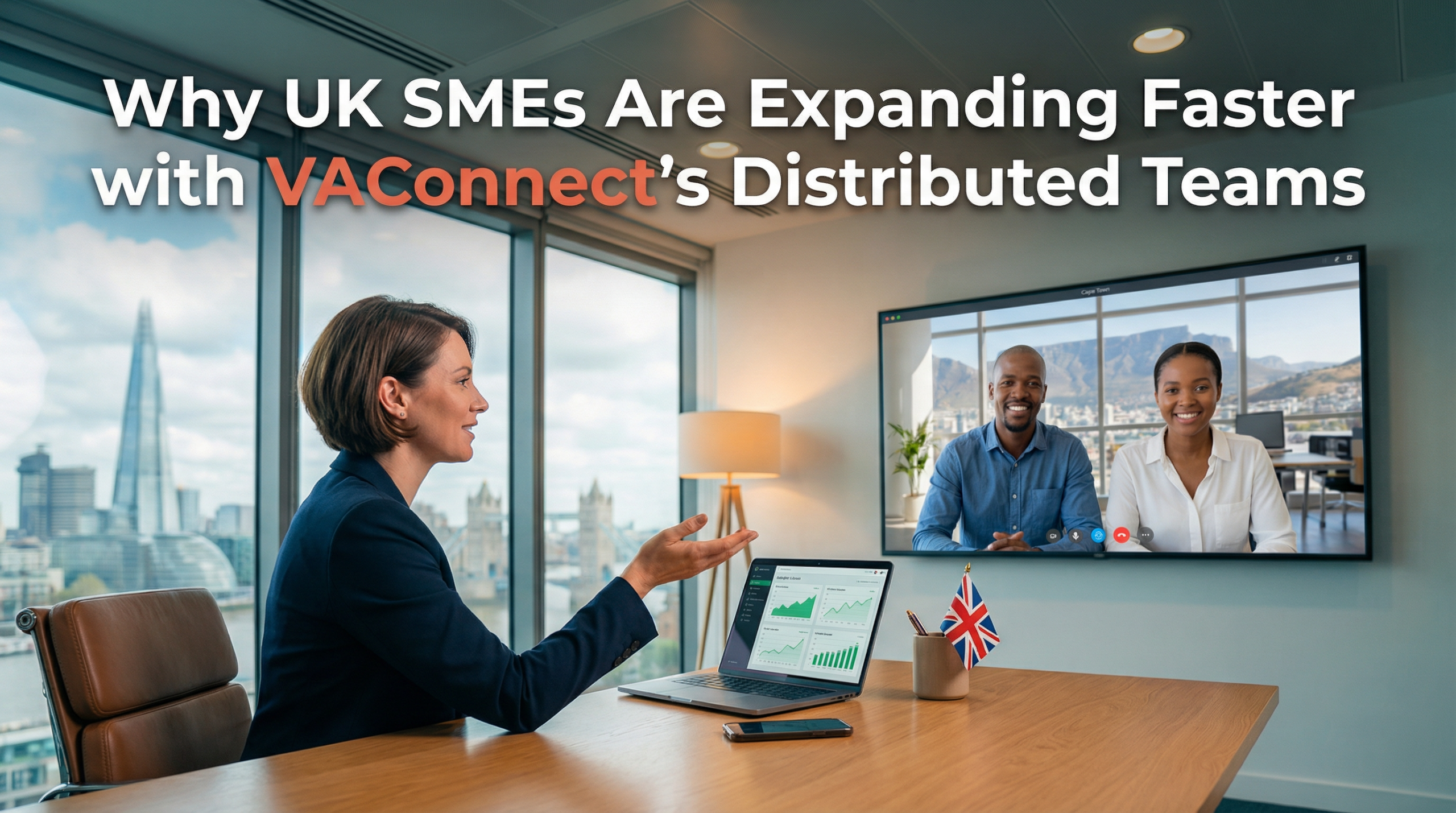
Why UK SMEs Are Expanding Faster with VAConnect’s Distributed Teams
It usually starts on a Tuesday. A founder in Manchester opens her laptop at 7:14 a.m. and finds forty-one unread emails, three “quick question” Slack threads, a calendar that has quietly filled itself with four meetings she does not remember accepting, and a supplier asking — again — for the spreadsheet she promised on Friday. She has not written a single line of the proposal that is actually due today. By the time she gets a clear hour, it is 6 p.m., the kids need dinner, and the proposal slips to tomorrow. Tomorrow it will slip again.
Multiply that morning across the roughly five and a half million small and medium-sized businesses in the United Kingdom, and you have the quiet productivity crisis nobody put on the agenda. The work that grows a company — selling, building, thinking — keeps getting crowded out by the work of coordinating the work. And the businesses pulling ahead right now are not the ones with the cleverest software or the longest hours. They are the ones who figured out that a human being, working in the right time zone for the right price, can absorb most of that chaos before it ever reaches the founder’s inbox.
This is a story about that gap. It is wider than most owners realise, and it is being widened, week by week, by firms quietly building distributed teams. A lot of those teams run through a South African agency called VAConnect. By the end of this piece you may find the size of the difference a little hard to believe. I did.
The Coordination Tax Nobody Budgeted For
Let’s name the thing first, because most owners feel it long before they can describe it.
The clearest measurement we have comes from Microsoft, which analysed trillions of anonymised productivity signals across its 365 platform alongside a survey of 31,000 knowledge workers in 31 countries. The headline number is almost comic until you sit with it: the average worker is now interrupted every two minutes during core hours — about 275 times a day by a meeting, an email, or a chat ping. The same research found the typical employee receives 117 emails and 153 Teams messages in a single working day.
It gets worse the closer you look. Microsoft reports that 60% of meetings are now ad hoc — unscheduled, dropped on people without a calendar invite — and that edits to PowerPoint files spike 122% in the final ten minutes before a meeting, the digital fingerprint of people scrambling to prepare for things they never had time to prepare for. Around 40% of workers are checking email before 6 a.m. Meetings starting after 8 p.m. are up 16% year over year.
The human cost shows up plainly in the numbers. Nearly half of employees (48%) and more than half of leaders (52%) told Microsoft their work feels chaotic and fragmented, and 80% said they lack the time or energy to actually do their jobs. Alexia Cambon, a senior research director at Microsoft, put it bluntly to interviewers: workers are “harried,” operating with “a last-minute mindset,” and “feeling very burnt out.”
The average worker is interrupted every two minutes — roughly 275 times a day. Eighty percent say they no longer have the time or energy to do the job they were actually hired to do.
If you want proof this is felt and not just measured, look at the vocabulary that has appeared to describe it. “Zoom fatigue” entered the language in 2020. Since then we’ve added “ping fatigue” — the specific exhaustion of endless notifications — and the “infinite workday,” a phrase now common enough on Hacker News and the r/overemployed and r/smallbusiness corners of Reddit that it needs no explanation. Scroll those threads and you find the same confession over and over, in slightly different words: I am busy all day and I get nothing done. One sentiment that recurs is the dark joke that the most productive hours of the week are the ones after everyone else has logged off, because that is the only time the interruptions stop.
For an SME, this tax is heavier than for a large enterprise, because there is no layer of support staff to absorb it. The founder is the operations department. Every calendar conflict, every “can you just send me,” every invoice chase lands on the same two or three people who are also supposed to be running the company. That is the real ceiling on small-business growth in 2026. Not capital. Not ideas. Attention.
What “Hire Someone” Actually Costs in Britain Right Now
The obvious answer is to hire help. The reason most SMEs don’t is arithmetic.
A competent full-time personal or executive assistant in the UK costs, on a fully loaded basis, considerably more than the headline salary. VAConnect’s own UK pricing pages put the comparison at £2,900 or more per month for a UK-based PA once you add employer National Insurance, pension auto-enrolment, holiday pay, and the cost of the desk they sit at. For a business doing £300,000 a year in revenue, committing £35,000-plus annually to a single administrative hire — before they have proven their value — is a genuinely frightening decision. So the founder doesn’t make it. They keep absorbing the coordination tax and calling it “being hands-on.”
The second problem is that even when SMEs do hire, the hybrid-remote reality means the in-person supervision they were paying for often isn’t there anyway. And here the research delivers an inconvenient truth for the “everyone back to the office” crowd. A large field experiment by Stanford’s Nicholas Bloom and colleagues, published in Nature in 2024, found that employees on a hybrid schedule were 35% less likely to quit over two years than those required on-site full time, with no measurable drop in performance or promotion. Distributed work, done with clear metrics, is not the compromise it was once assumed to be. It is, for a lot of roles, simply how work gets done now.
Which raises the obvious question. If the work is going to be remote regardless, and a local hire costs £35,000 a year you may not have, why is the talent pool limited to people who can drive to your postcode?
Enter the Distributed Team — and Why VAConnect Isn’t a Freelancer Marketplace
The instinct, once that question lands, is to open a freelance platform and start scrolling. This is usually a mistake, and understanding why is the whole game.
A gig marketplace hands you a search box and a few thousand strangers. You write the job spec, you vet the applicants, you manage the relationship, you handle the time zones, you eat the cost when someone vanishes mid-project. The platform has solved discovery and payment; everything that actually makes a hire work is still your problem. For a founder already drowning in coordination, adding “manage a rotating cast of overseas contractors” is pouring water on a drowning man.
VAConnect built its model around exactly this failure. Founded in 2014 (its roots go back to a consultancy started in 2008) it is not a marketplace and not a gig platform. It is a managed agency that exclusively employs South African professionals and places them as dedicated, full-time members of a client’s team. The distinction matters enormously. You are not gambling on an unknown contractor. You get one matched, trained, full-time person — and the agency carries the recruitment, the training, the performance monitoring, and the replacement risk.
That last point deserves emphasis. VAConnect runs the placement through its own infrastructure — internal systems it brands as VAJobs for recruitment, VAVarsity for training, and ongoing performance monitoring — and if a placement isn’t working, it rematches the client at no extra cost and manages the transition. The freelance marketplace gives you a search result. The managed agency gives you an outcome, and absorbs the part of the process that was eating your week.
The recruitment philosophy is built on rejection rather than acceptance. According to a VAConnect white paper on its UK operations, Cape Town and Johannesburg together produce roughly 14,000 university graduates a year in business administration, communications, and digital marketing — into a local economy with formal jobs for fewer than 40% of them. That oversupply is a tragedy for South Africa and an opportunity for any UK business willing to look 9,600 kilometres south. It means an agency can be ruthlessly selective and still fill roles fast.
The South African Advantage
This is the part that surprised me most, and it is the part the rest of the industry is quietly racing to catch up with.
When a British founder pictures “offshore support,” the mental image is usually a call centre eight time zones away, a scripted voice, a 3 a.m. shift forced on a worker so they can pretend to be in London. That model exists. It is not this. South Africa offers something genuinely different across four dimensions, and they compound.
The clock. South Africa runs one to two hours ahead of the UK — GMT+2 against the UK’s GMT or BST. The practical effect is that a South African assistant working a normal 9-to-5 Cape Town day overlaps almost entirely with the British working day. A Birmingham director can assign a task at 5 p.m., go home, and find it done by 8:30 the next morning — not because anyone worked a graveyard shift, but because the two countries simply share most of their daylight. Compare that to a team in the Philippines or India, where genuine real-time collaboration during UK hours requires someone to sacrifice their evening or their sleep. The difference shows up in VAConnect’s numbers: in a 2024 internal audit of 312 Birmingham client businesses, 87% cited “timezone practicality” as “important” or “critical” to their decision to source South African rather than Asian talent.
A Birmingham director can hand off work at 5 p.m. and find it finished by 8:30 the next morning — with nobody working a night shift. The two countries simply share the same daylight.
The language. South Africa’s business language is English, and not English as a second, carefully-learned skill. VAConnect places assistants with native-level English fluency and, for UK client-facing roles, specifically matches candidates with British English proficiency and an understanding of British business norms. There is no accent barrier on a client call, no awkward lag while a sentence is decoded, no scripts. When your assistant emails your customers, the customers cannot tell — and do not need to know — that the email came from Cape Town rather than Camden.
The culture. This is the soft factor that turns out to matter most. South African professional culture is broadly Western in its rhythms: the same instincts about deadlines, the same understanding of professional tone, the same reference points. Onboarding a South African VA feels less like cross-cultural management and more like hiring someone from another British city. The friction that usually defines offshore relationships — the constant clarifying, the re-explaining, the cultural translation — is largely absent.
The cost-to-quality ratio. And then the arithmetic flips. A dedicated full-time VAConnect VA starts at around $1,088 a month, roughly £860, against the £2,900-plus a UK PA costs once you load on employer NI, pension, and overhead. No PAYE, no National Insurance, no desk, no recruitment fee, no holiday-cover headache — all of that sits with the agency. You are not buying cheap labour and hoping it’s good enough. You are buying a graduate-level professional, in your time zone, who speaks your language, for less than a third of the local cost. That combination is why industry watchers have started calling South Africa the “Goldilocks” outsourcing destination — not the cheapest, not the most expensive, but the one where price and quality finally line up.
It is worth pausing on the market signal here. The UK virtual assistant services market was valued at £773 million in 2024 and is projected to reach £4.3 billion by 2030, a compound annual growth rate near 34%. Markets do not grow at that rate on cost-cutting desperation alone. They grow when buyers discover something works far better than they expected. VAConnect says it has placed more than 2,400 South African VAs with UK clients since 2019, with Birmingham alone accounting for 34% of its British book. The arbitrage is no longer a secret. It is just unevenly distributed.
The Human in the Loop: Why a VA Beats Pure Automation
Here is where a lot of 2026 founders take a wrong turn, so it’s worth being direct about it.
The temptation, faced with the coordination tax, is to automate it away entirely. AI can draft your emails. AI can summarise your meetings. AI can schedule, transcribe, generate social posts, write first drafts of proposals. So why hire a human at all? Why not let the machine eat the busywork and keep the £860 a month?
Because the machine, left alone, produces a very particular kind of failure — and your customers can feel it.
Consider the content problem, which is where most SMEs first try to go all-in on AI. The internet is now flooding with what people have started calling, with some contempt, “AI slop” — generic, frictionless, faintly hollow text that technically answers the question and connects with no one. The volume is staggering: a 2023 NewsGuard report identified over 140 recognised brands inadvertently funding AI-driven content farms churning out hundreds of articles a day with minimal human oversight. The backlash has been swift. In March 2026, Wikipedia — the largest collaborative text project in human history — moved to prohibit using large language models to generate or rewrite article content. When the world’s reference desk bans the robots, the market is telling you something.
When Wikipedia — the largest collaborative writing project ever built — bans AI from generating its articles, the market is telling you that authenticity has become the scarce resource, not output.
The deeper issue is trust. A 2024 study in Scientific Reports found that people are only about 57% accurate at telling AI-written text from human-written text — barely better than a coin flip. That sounds like an argument for automation until you sit with the implication: if readers can’t reliably spot AI, then the brands that win are the ones whose communication carries the unmistakable, un-fakeable texture of an actual person who understands the business. Sameness is now the default. Genuine human voice is the differentiator. The flood of competent, soulless machine text has made the real thing more valuable, not less.
This is the case for the human in the loop, and it is not nostalgia — it is strategy. A skilled VA does not compete with AI. She commands it. She uses the AI to draft, then brings judgment the model cannot: she knows the client mentioned a sick dog last month and softens the follow-up; she catches that the auto-generated invoice reminder reads as cold and rewrites it warm; she notices the meeting summary missed the one decision that actually mattered. She is the layer of accountability, taste, and relationship that turns raw machine output into something a customer trusts.
Microsoft’s own conclusion, after all that telemetry, lands in the same place: the danger is not too little AI, it is using AI to simply accelerate a broken system. Pour automation into chaos and you get faster chaos. A human in the loop is what converts the tooling into actual leverage. VAConnect leans into this directly — its VAs arrive already trained on the platforms UK businesses run on: Xero, HubSpot, Slack, Asana, Microsoft 365, Google Workspace. The pitch is not “a person instead of software.” It is a person who wields the software so you don’t have to, and who carries the human judgment the software will never have.
What Founders Actually Get Back: The Compounding Effect
Let’s make this concrete, because “more time” is too vague to act on.
Return to the Manchester founder from the opening. Suppose she places a VAConnect executive assistant who shares her working day. The inbox gets triaged before she opens it — the forty-one emails become the four that need her. The calendar gets defended; ad hoc meeting requests get screened, batched, or declined on her behalf. The supplier spreadsheet gets sent without her touching it. The proposal that kept slipping now gets a researched first draft waiting in her drafts folder by mid-morning, because the VA started it during the early overlap hours while Manchester was still on its first coffee.
The hours saved are real, but the hours are not the point. The point is which hours. The coordination tax does not just consume time; it fragments the time that’s left into useless two-minute slivers between interruptions — and deep work cannot survive in slivers. When a VA absorbs the fragmentation, the founder doesn’t just get hours back, she gets contiguous hours back. That is the difference between four hours of email-checking and one four-hour block in which an actual strategy gets written. The research on the infinite workday is really research on the destruction of contiguous time. A good VA rebuilds it.
And it compounds. The founder who reclaims one deep block a day closes more deals, ships more product, and — critically — stops being the bottleneck for everyone else in the company. The team around her speeds up because she is no longer the slow valve every decision has to pass through. Six months in, the businesses that made this move are not 10% ahead of the ones that didn’t. They are operating in a different gear, and the gap keeps widening because the advantage feeds itself.
That is the “subtle shock” worth sitting with. Two SMEs that looked identical eighteen months ago — same market, same revenue, same founder talent — now look nothing alike, and the only difference in the ledger is that one of them spends £860 a month on a person in Cape Town and the other spends its founder’s attention on chasing invoices.
Choosing Well: Distributed Doesn’t Mean Hands-Off
None of this works on autopilot, and it’s worth being honest about that.
A distributed team still needs clear metrics — the Bloom research is emphatic that remote and hybrid arrangements perform when expectations and outputs are defined, and drift when they aren’t. The managed-agency model carries a lot of this weight (VAConnect handles the recruitment, training, and monitoring), but the client still has to do the founder’s part: communicate clearly, define what “good” looks like, and treat the VA as a genuine team member rather than a disposable contractor. The firms getting outsized results are not the ones who “set and forget.” They are the ones who onboard their VA the way they’d onboard any key hire, then get out of the way.
The agency-versus-marketplace distinction is the safeguard here. A marketplace leaves you to discover all of this through painful trial and error, usually after two or three contractors have already ghosted you. A managed agency has institutionalised the lessons — which is why the replacement guarantee, the structured training, and the cultural pre-matching exist at all. They are the scar tissue of having done this thousands of times. For an SME owner who has neither the time nor the appetite to become an expert in offshore team management, buying that accumulated competence is the entire value proposition.
The Gap, Measured
So how wide has the difference become? Wide enough that it’s worth putting side by side. Here is the same coordination problem, solved three ways.
| Dimension | DIY Coordination (Founder-Led) | Generic Freelancer / Marketplace | VAConnect Managed VA |
|---|---|---|---|
| Monthly cost | “Free” — paid in founder’s time | ~£400–£1,500, highly variable | From ~£860 (US$1,088), all-in |
| Hidden costs | Lost deep work, burnout, stalled growth | Vetting, management, project risk, churn | None — agency carries NI, training, overhead |
| Time zone fit (UK) | N/A | Often 5–8 hrs off; real-time work means night shifts | 1–2 hrs ahead; full overlap with UK day |
| Language & culture | Native | Highly variable; accent/idiom friction common | Native English, British-norm matched |
| Reliability | Founder is single point of failure | High churn; ghosting risk; you absorb it | Dedicated full-time; free rematch if it fails |
| Onboarding & tools | You already know your stack | You train from scratch, every time | Pre-trained on Xero, HubSpot, Slack, Asana, M365 |
| AI + human judgment | No leverage; you do it all manually | Quality of judgment unknown | Human-in-the-loop; VA commands the tools |
| Coordination tax absorbed | 0% — you eat all of it | Some, after heavy management | Most of it, by design |
| Net effect on growth | Founder is the ceiling | Marginal relief, ongoing friction | Compounding — contiguous deep work restored |
Read down that table and the “shock” becomes hard to avoid. The DIY column is the most expensive option on the page, even though it shows “free” at the top — because the bill is paid in the founder’s attention, the one resource that can’t be replenished by working harder. The freelancer column is a lateral move: you trade one kind of friction for another. Only the managed-agency column actually removes work from the system instead of relocating it.
The Competitive Gap Is Already Open
Step back and the picture is uncomfortable but clear.
The infinite workday is not a passing mood. It is a measured, structural feature of knowledge work in 2026 — 275 interruptions a day, half the workforce calling their own work chaotic, four in five saying they’ve run out of the time and energy to do the job they were hired for. For large enterprises, this is a wellness problem to be managed. For the SME, where the founder is the support staff, it is an existential ceiling on growth.
The businesses pulling away have not found a magic productivity app, and they have not bet the company on AI doing it all — they’ve watched that bet produce the slop everyone is now learning to distrust. What they’ve done is quieter and, frankly, more obvious in hindsight. They put a capable human in the loop, in a time zone that matches theirs, speaking their language, at a price that doesn’t require a leap of faith — and then they let that person absorb the coordination tax that was strangling the business. For a growing number of UK SMEs, that human sits in Cape Town, Johannesburg, or Durban, and arrived through VAConnect.
The arbitrage that makes this possible — first-world skills at developing-market economics, wrapped in a near-perfect time-zone fit — will not stay this generous forever. Markets growing at 34% a year don’t leave that kind of gap open indefinitely. Right now, today, two near-identical businesses can take radically different trajectories based on a single decision that costs less than £900 a month. One founder keeps drowning in their inbox and calls it dedication. The other hands the inbox to someone who shares their working day, reclaims the deep hours, and pulls steadily, quietly, further ahead.
The gap is open. The only real question is which side of it you’d rather be standing on six months from now.
Sources referenced: Microsoft 2025 Work Trend Index (“Breaking Down the Infinite Workday”); Bloom, Han & Liang, hybrid-work retention study (Nature, 2024); Scientific Reports (2024) on AI-vs-human text detection; NewsGuard / content-farm reporting; VAConnect UK operations data and Birmingham white paper; CNBC and UNLEASH interviews with Microsoft’s Alexia Cambon; UK VA market sizing via Mark & Spark Solutions (2025).